
Introduction: what is robot programming and what are the goals
Robot programming involves creating the logic, paths, and communications that enable an industrial robot to perform tasks such as palletizing, pick‑and‑place, welding, assembly, testing, or inspection. The goal of programming is for the robot to work safely, efficiently, accurately and repeatably, with minimal downtime and maximum productivity. A good program includes: kinematics and dynamics, optimized paths, gripper and sensor integration, communication with PLC/HMI systems, error handling and diagnostics (IO‑Link, RFID, vision).
What Robot Programming Contain — Key Components
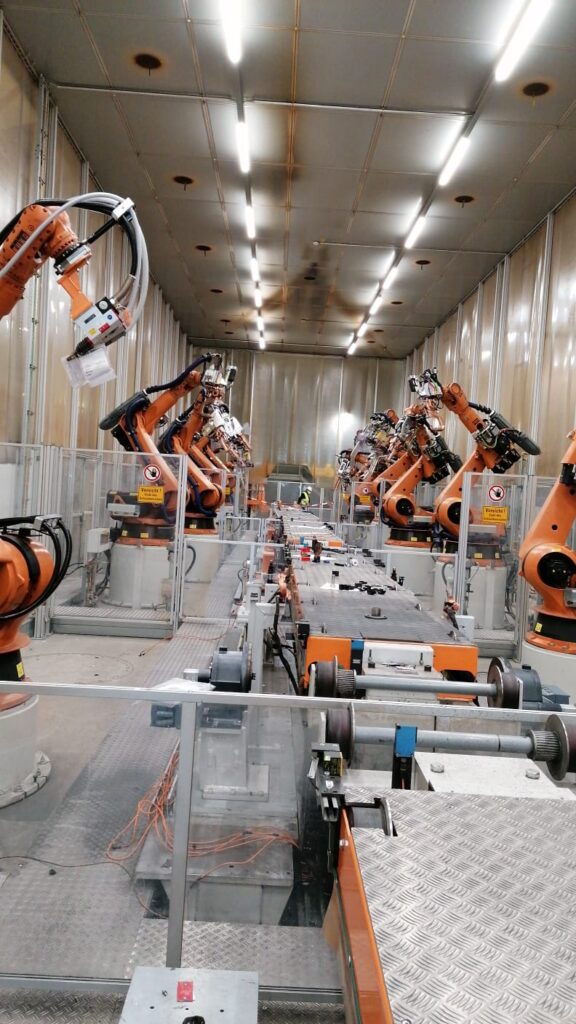
- Task definition and timing: process analysis and timing.
- Creating paths and points: teach‑point or offline programming.
- Synchronization with PLC/HMI: I/O mapping, safety zones, interlocks.
- Integration of peripheral devices: grippers, cameras, code readers, RFID.
- Performance optimization: speed, acceleration, cycle reduction.
- Safety and simulation: collision detection, safe zones, virtual commissioning.
- Maintenance and diagnostics: logs, IO‑Link data, remote support.
Advantages and disadvantages by brands (short and practical)
| Atribut | KUKA | FANUC | ABB | Yaskawa | Nachi‑OTC / Others |
|---|---|---|---|---|---|
| Precision / repeatability | High | High | High | High | It varies |
| Range and payload | A wide spectrum | A wide spectrum | A wide spectrum | Good for medium loads | Specific models |
| Ecosystem and software | Powerful (KUKA.WorkVisual) | Strong (ROBOGUIDE) | Powerful (RobotStudio) | Good tools | Less integrated tools |
| Service and support | Good in the EU | Global network | Global network | Good regional support | Varies by manufacturer |
| Price / TCO | Higher starting price | Medium-high | Medium-high | Competitive | Lower price on some models |
KUKA
Advantages: excellent for complex applications; powerful software for offline programming; good integration with the industrial ecosystem.
Disadvantages: higher initial price; requires experienced developers for advanced applications.
FANUC
Advantages: exceptional reliability; large global service network; robust controllers and simulation software.
Disadvantages: Can be more expensive for specific add-ons; proprietary ecosystem.
ABB
Advantages: powerful RobotStudio for offline programming and simulation; good integration for welding and handling.
Disadvantages: sometimes more complex configuration for smaller teams.
YASKAWA
Advantages: competitive price; good for medium and fast applications; reliable motors and controllers.
Disadvantages: regional support varies; less specialized tools in some cases.
Nachi‑OTC i drugi japanski proizvođači
Advantages: robustness, specific models for welding and assembly; often an excellent price-quality ratio.
Disadvantages: less global presence in some models; spare parts may be more expensive outside the region.
Briefly about collaborative robots (cobots)
Cobots are designed to work alongside humans without extensive safety fences (with proper risk assessment). They are ideal for: assembly, pick‑and‑place, testing and assistance. Advantages: quick implementation, flexibility, smaller footprint. Disadvantages: limited speed and carrying capacity compared to industrial robots; for more difficult tasks and high speeds, traditional robots are still better.
Chinese robots — growth, benefits and risks
Chinese robots (e.g. Fanuc‑competing models and new OEMs) are quickly conquering the market due to lower cost, rapid development and aggressive functionalities. Advantages: cheaper price, quickly available models, often good basic functionality for simple applications. Risks: component quality varies, potential long-term reliability issues, availability of original spare parts and service support may be limited. For critical production lines, caution is recommended: test the robot in real conditions, ensure a stock of spare parts and a service plan.
Adjan AutoPro — what sets us apart
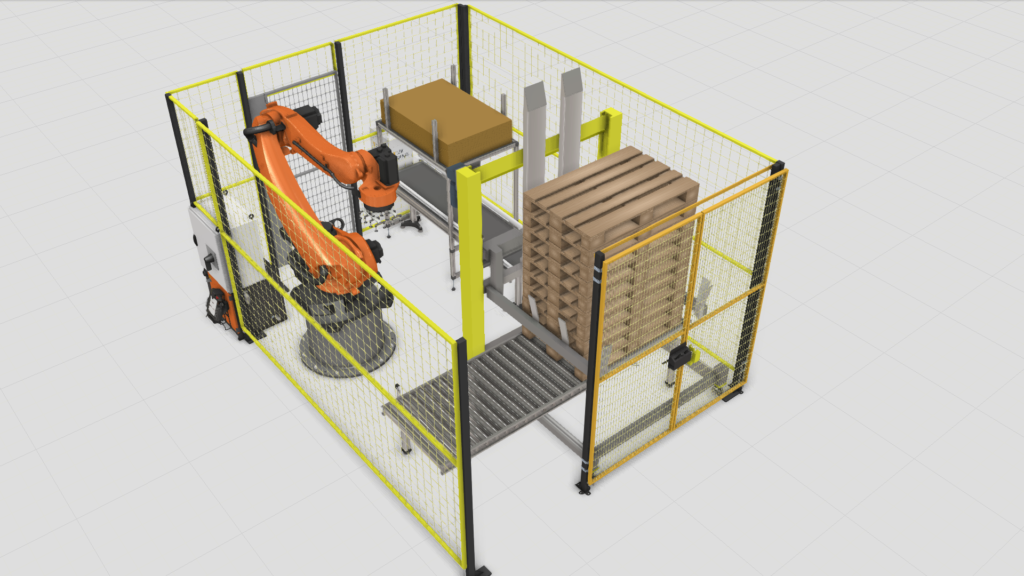
Adjan AutoPro programs a large number of types of industrial robots and we have an advanced 3D simulation system in which we have over 2,400 different models of robots from all manufacturers. Before we recommend a purchase or finally choose a robot for a specific application, we test the reaches, trajectories, speeds and interaction with grippers and peripherals in a simulation. In this way, the risk of making the wrong choice is significantly reduced, commissioning is accelerated, tact and total cost of ownership (TCO) are optimized, and costly interruptions in production are avoided. If you want, we can do a simulation for your line and show you the results before you make a decision.
Conclusion
Although industrial robots do not differ drastically in principle of operation and basic components, choosing the right company for integration is crucial for the success of the project. Improper programming of the robot, poorly adjusted movement parameters and inadequate integration of peripheral devices can shorten the life of the robot, increase the wear and tear of mechanics and drive elements, and lead to more frequent downtime and higher maintenance costs.
Key factors to check in an integrator are: experience with specific brands and applications, ability to do offline 3D simulation and reach and tact testing, clearly defined procedures for safety and diagnostics, standard robot programming, as well as a plan for training and support after commissioning. Pre-purchase simulation and testing significantly reduce risk and enable performance optimization before the robot reaches the line.
Proper robot programming includes optimization of trajectories, acceleration and braking, adequate error management and integration with PLC/HMI and sensors. Regular monitoring, prevention and availability of spare parts are equally important — poor maintenance is often a greater cause of shortened equipment life than the initial configuration itself.
Adjan AutoPro offers experience for robot programming and integration of different robots, advanced 3D simulation